
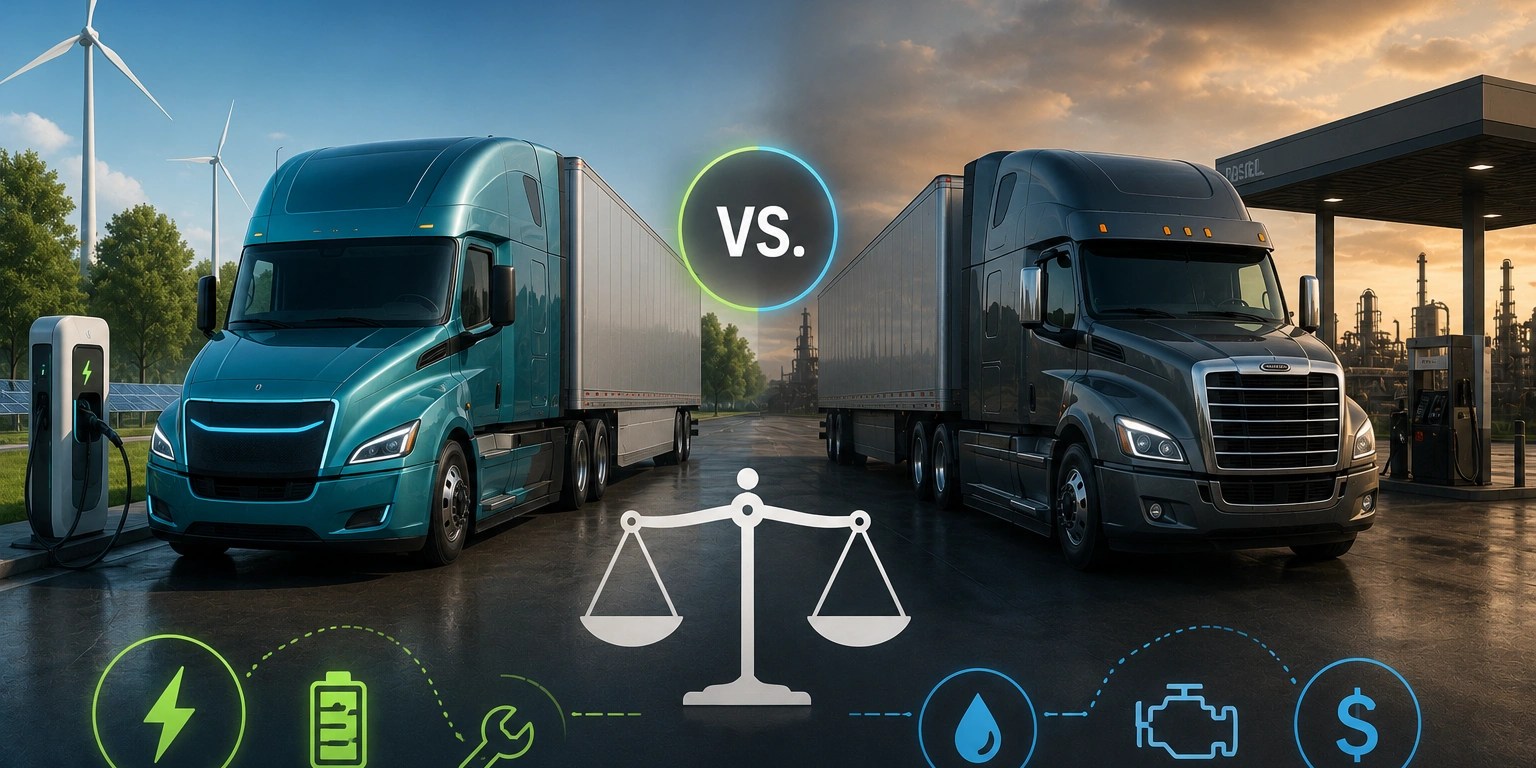
The question of whether to electrify commercial fleet vehicles has moved firmly from the realm of environmental policy discussion into capital budgeting. With Class 8 electric trucks now available from multiple manufacturers, a growing infrastructure network developing across major freight corridors, and total cost of ownership projections that favor electrification on specific route profiles, fleet managers are being asked to make procurement decisions with real financial consequences in both directions.
Getting this decision wrong is expensive. Electrifying a fleet that isn’t operationally suited for it means absorbing higher upfront costs, range constraints, and charging infrastructure investment without capturing the fuel and maintenance savings that justify the premium. Not electrifying when the economics genuinely favor it means forgoing cost reductions that competitors may be capturing — and potentially missing incentive windows that are narrowing as government programs evolve.
Here is the framework every fleet manager needs to evaluate the electric vs. diesel decision for their specific operation.
The Current State of Electric Truck Technology
Battery-electric commercial trucks have moved beyond the prototype stage into commercial production. The Freightliner eCascadia, Kenworth T680E, Peterbilt 579EV, Volvo VNR Electric, and BYD Class 8 tractors are all commercially available. Range capabilities for Class 8 battery-electric trucks currently run 200 to 330 miles per charge depending on load, route grade, and ambient temperature — figures that are improving with each new battery generation but remain significantly below the 1,000-plus miles achievable on a single diesel fill for over-the-road applications.
Medium-duty electric trucks — Class 4 through Class 6 — have matured faster than Class 8 and are viable for a broader range of applications. The Mercedes-Benz eSprinter, Ford E-Transit, and Rivian Commercial Van (widely deployed by Amazon) have demonstrated commercial reliability at scale. For urban delivery fleets, last-mile logistics, and service vehicles operating return-to-base routes under 150 miles, medium-duty electric vehicles have crossed the threshold from early-adopter technology to mainstream procurement consideration.
The primary technical constraints that define where electric trucks work — and where they don’t — are range, charging time, and payload capacity impact. Battery weight reduces payload by 2,000 to 4,000 pounds on Class 8 vehicles, a consideration that matters significantly for weight-sensitive freight. Charging from 20 percent to 80 percent on a DC fast charger takes 60 to 90 minutes — time that must be built into route planning.
Total Cost of Ownership: Where the Numbers Actually Land
Upfront purchase price comparisons between electric and diesel trucks are misleading in isolation. A Class 8 electric tractor costs $350,000 to $450,000 compared to $180,000 to $200,000 for a new diesel equivalent — a premium of $150,000 to $250,000 per vehicle. At that difference, the business case for electrification depends entirely on operational savings that accumulate over the vehicle’s service life.
The savings categories that drive electrification ROI are fuel cost and maintenance cost. Electric trucks pay approximately $0.08 to $0.12 per mile in energy cost at commercial electricity rates — compared to $0.35 to $0.50 per mile for diesel at current fuel prices. That differential represents $0.23 to $0.42 per mile in fuel savings — which, at 80,000 miles per year, means $18,400 to $33,600 in annual fuel savings per truck.
Maintenance savings are equally significant. Electric drivetrains eliminate the engine, transmission, exhaust system, diesel particulate filter, selective catalytic reduction system, and dozens of associated components that represent the majority of commercial truck maintenance spend. Early fleet deployments are reporting 40 to 60 percent reductions in total maintenance cost per mile for electric trucks compared to diesel equivalents — a saving that grows as trucks age and diesel maintenance costs typically increase.
Combined, fuel and maintenance savings of $25,000 to $50,000 per truck per year can close the purchase price gap within 3 to 7 years depending on utilization, electricity rates, and diesel prices. That payback timeline places electrification within the planning horizon of most commercial fleet capital cycles — but only for specific operational profiles.
The Routes Where Electrification Makes Financial Sense
The operational profile that delivers the strongest electric truck ROI shares consistent characteristics across fleet types and geographies:
- Return-to-base daily routes under 200 miles, allowing overnight charging at a depot rather than requiring en-route public fast charging
- Urban and regional distribution, where stop-and-go operation enables regenerative braking to extend range and reduce brake wear simultaneously
- High utilization, where the fixed cost premium of electric trucks is amortized across more miles, accelerating the payback period
- Access to off-peak commercial electricity rates, which can drop the energy cost per mile to $0.05 to $0.08 — improving the fuel savings equation significantly
- Consistent routes with predictable grade profiles, where range can be reliably modeled rather than managed as a variable
Beverage distribution, food service delivery, parcel and last-mile logistics, refuse collection, and utility service fleets have documented the strongest ROI on electric truck deployments. These applications share the short-range, return-to-base, high-cycle characteristics that maximize the technology’s financial advantages.
Where Diesel Continues to Win
For long-haul over-the-road trucking, diesel remains the economically superior option in the current technology generation. A Class 8 diesel tractor running 500 to 700-mile daily cycles across varied terrain and diverse weather conditions cannot be practically or economically operated on battery-electric technology today. The range limitation, the charging time requirement, and the absence of adequate fast-charging infrastructure along most long-haul corridors make electrification operationally impractical for these applications — regardless of the financial incentives available.
Vocational applications with heavy payload requirements — concrete mixers, dump trucks, heavy-haul flatbeds operating at or near gross vehicle weight limits — face the compounding challenge of battery weight reducing available payload in applications where every pound of payload capacity represents revenue. The economics of electrification are significantly weaker when the battery premium includes both purchase cost and reduced freight capacity.
Fleet operators in markets without strong utility infrastructure or favorable commercial electricity rates will find longer payback periods that reduce the financial case for early adoption. The electrification ROI calculation is highly sensitive to the cost of electricity — in markets where commercial rates are high or off-peak pricing is unavailable, fuel savings shrink and the timeline to cost parity extends accordingly.
Infrastructure: The Capital Requirement That Changes the Calculation
The vehicle acquisition cost is not the only capital commitment electrification requires. Depot charging infrastructure — the electrical capacity upgrades, transformer installations, charging stations, and grid connection work needed to charge a fleet overnight — adds $50,000 to $200,000 or more in upfront infrastructure cost depending on fleet size and site conditions.
Utilities in many markets are working through multi-year queues for service upgrades, meaning the timeline from electrification decision to operational readiness extends well beyond vehicle delivery. Fleet managers who underestimate the infrastructure planning horizon find themselves with electric trucks and inadequate charging capacity — a situation that undermines the operational and financial case that justified the investment.
Early engagement with utility providers — ideally 12 to 24 months before planned vehicle delivery — is the most consistently cited lesson from fleet operators who have navigated successful electrification programs. Utility programs that subsidize infrastructure costs for commercial customers are available in many markets and can offset a significant portion of the depot investment, but they typically require application well in advance of project commencement.
Building the Evaluation Framework for Your Fleet
The electric vs. diesel decision cannot be made at the fleet level — it must be made at the route-and-application level, with different conclusions potentially applying to different vehicle classes and operational segments within the same organization. A long-haul division and an urban delivery division operating under the same corporate umbrella may reach opposite conclusions about electrification economics, and both conclusions may be correct.
The analytical framework requires modeling total cost of ownership over a realistic vehicle lifecycle (8 to 10 years for most commercial trucks), incorporating actual electricity and diesel pricing for your operating market, accounting for infrastructure capital at realistic cost-per-vehicle amortization, applying available incentives accurately and conservatively, and stress-testing the model against fuel price scenarios and utilization variance.
For fleet operators conducting this analysis, a comprehensive fleet electrification ROI cost-benefit framework provides the structured methodology for modeling electrification economics against specific operational parameters — including payback timeline calculations, incentive integration, and the route-level analysis that determines where the business case is strongest.
The Role of Fleet Management Technology in Transition Planning
Fleets that are actively managing the electrification evaluation or planning a transition need accurate baseline data on their current fleet’s performance — cost per mile by vehicle and route, utilization rates, fuel consumption patterns, and maintenance cost histories — to build credible projections and identify the right candidates for early electrification.
Fleet management platforms that consolidate telematics data, maintenance records, fuel consumption, and cost tracking generate the operational baseline that rigorous electrification analysis requires. They also provide the ongoing performance monitoring needed to validate that electric truck deployments are delivering projected savings — and to identify operational adjustments when they’re not.
For fleet managers evaluating the technology investment required to support both current operations and future electrification planning, the fleet asset management software ROI calculator at Heavy Duty Journal walks through the full cost-benefit framework for fleet management platform investment — including how data infrastructure built for current diesel operations directly supports the baseline analysis electrification decisions require.
The Decision Framework in Practice
The electric vs. diesel decision, evaluated rigorously, produces a clear answer for most fleet operators: electrify the routes that fit the technology’s current capabilities and economics, maintain diesel for the applications where it remains superior, and build the operational and data infrastructure that makes future transitions progressively less disruptive.
This is not a binary choice between all-in electrification and permanent diesel commitment. It is a portfolio management decision — matching the right propulsion technology to the right application based on real operating data and honest financial modeling. The fleets that approach it that way will capture the savings available on favorable routes while protecting operational effectiveness on routes where diesel remains the economically superior choice.
The analysis takes time and requires quality data. Starting that process now — before a procurement decision is imminent — is the fleet manager’s most valuable contribution to getting it right.
About the Author:- Michael Nielsen is the editor and publisher of Heavy Duty Journal, a free digital trade publication serving diesel technicians, fleet managers, and owner-operators in the commercial trucking industry. He brings 15+ years of hands-on experience in diesel repair and fleet operations to HDJ’s editorial coverage.
 Huff Post Business Blog